
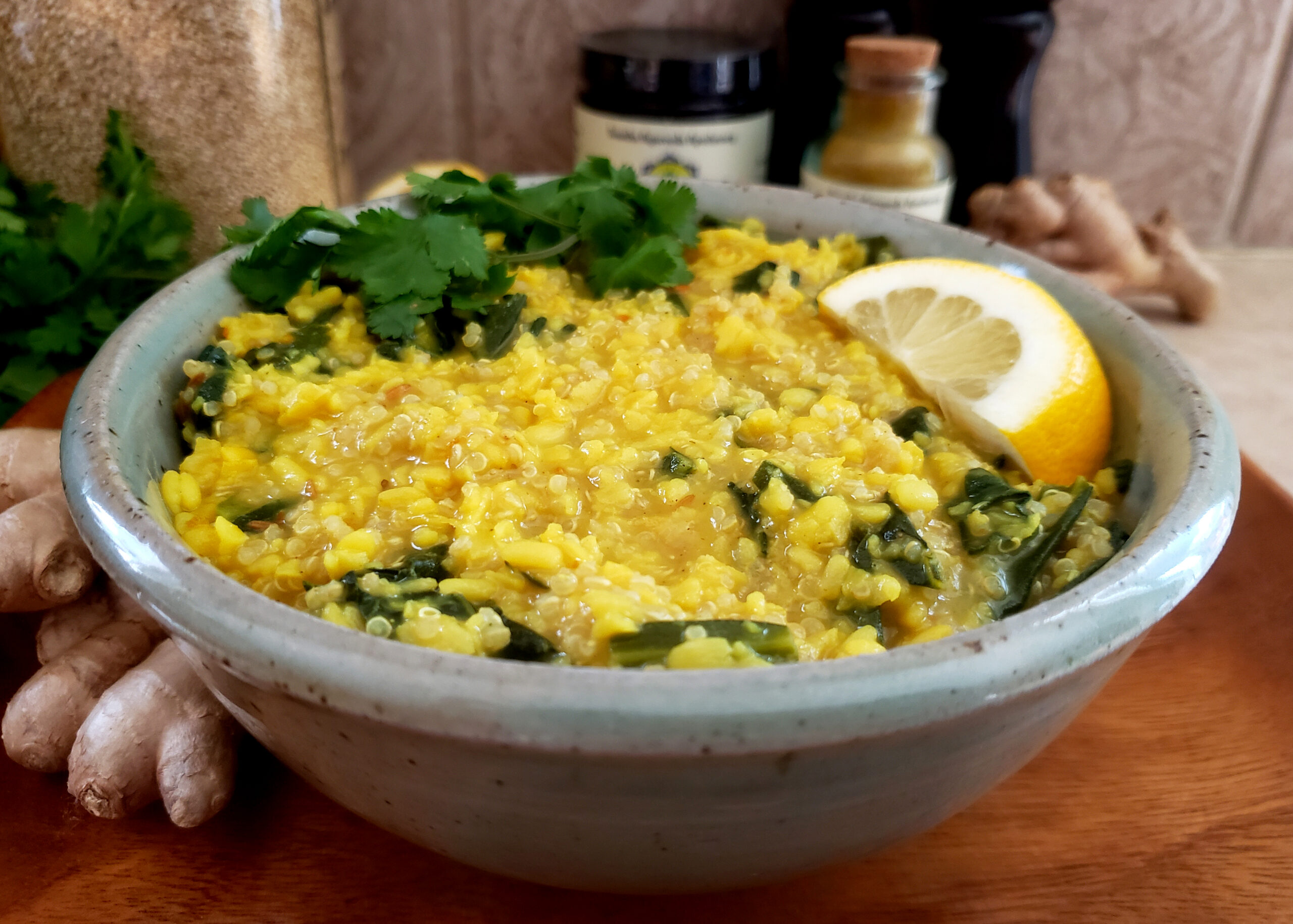
 If you love kitchari as much as I do, you will LOVE this quick, easy, well-balanced, and delicious recipe! Although kitchari can be made in a variety of ways, I wanted to keep this recipe simple, Sattvic (pure, balanced), and tridoshic by using fresh greens, a flavorful but balanced spice blend, fresh ginger, and ghee; I kept out the onion, garlic, and chiles, which can add a nice flavor, but are too heating for many indiviudals (sadly, including myself).
Read more on the what, why, and how of kitchari here!
Besides being balanced, this recipe is very simple and ready in 30 minutes. As a busy working mom, this recipe has allowed me to eat fresh, flavorful, home-cooked meals without the added stress. I have cut a few corners by skipping the initial step of sautéing the spices, using only one accessible and easy-to-prep vegetable, and by preparing the veggies, ginger, and rice (or quinoa) while the dal cooks.
Despite cutting a few corners, this recipe is far from being dull or boring. This recipe uses split mung (moong) dal, Basmati rice (or, my preference, quinoa), leafy greens, flavorful (but tridoshic) Ayurvedic spices, and, of course, ghee! I always use homemade bone broth as my base, which gives it more flavor and makes it more nourishing; however, if you are vegetarian or vegan, veggie broth or water works just as well!
Get your kitchari supplies here!
Being Sattvic (meaning pure and balanced) by nature, this recipe is considered tridoshic and beneficial for all dosha types (i.e. Vata, Pitta, Kapha). It is easy to digest for most individuals and is a great recipe for a Kitchari Cleanse, during times of sickness, or as a weekly staple for strengthening digestion and balancing your doshas. It can be enjoyed all year round and eaten multiple times a day or week!
Although this recipe is made to be quick and easy, there are a few key steps I kept in to preserve more flavor and texture. In fact, these steps are my “kitchari essentials” anytime I am cooking kitchari (and I eat a lot of kitchari). Thankfully, they do not add too much additional time and are well worth the small amount of effort they require.
So what are they already?? The first kitchari-must is that I always use fresh ginger and turmeric. Using them as dried spices is fine when you are in a pinch or if they are simply not available, but if you have them available—use them, you won’t regret!
The second rule I always stand by is to cook my rice (or quinoa) separately from my dal (then I blend when serving). I have found that this makes the kitchari less mushy, as the grain retains its texture much better. This is even more important if you plan to have leftovers. This step does not increase the cooking time since I cook the grain at the same time as the dal; however, it does require an additional pot to wash (not ideal but worth it!).
MAKE IT VEGAN
- Use homemade veggie broth or water instead of meat or bone broth.
- Use coconut oil (Pitta), sesame oil (Vata), or olive oil (Kapha) instead of ghee.
MAKE IT GLUTEN-FREE
- No changes needed! This recipe is already gluten-free.
- For those extra sensitive to gluten, make sure your dal and grains have been processed in a gluten-free factory.
MAKE IT GRAIN-FREE
- Replace the grains (rice or quinoa) with cauliflower rice.
- If cauliflower rice is unavailable, omit the grain and make a veggie and dal soup by adding a few extra veggies such as cauliflower, celery, or carrots. NOTE: Since these veggies take longer to cook, add them after 10 minutes of cooking the dal.

Simply Sattvic Kitchari Recipe
Click here for a printable copy of this recipe.
- Doshic effect: Vata↓, Pitta↓, Kapha↓
- Serves: 3
- Prep Time: 5 minutes (plus soaking time)
- Cook Time: 25 minutes
Materials
- Large saucepan (I use a 3-quart)
- Medium saucepan (I use a 2-quart)
- Cutting board and knife
- Stirring spoon
- Measuring spoons and cups
- Spice grinder or ginger grater (if using fresh ginger and/or turmeric)
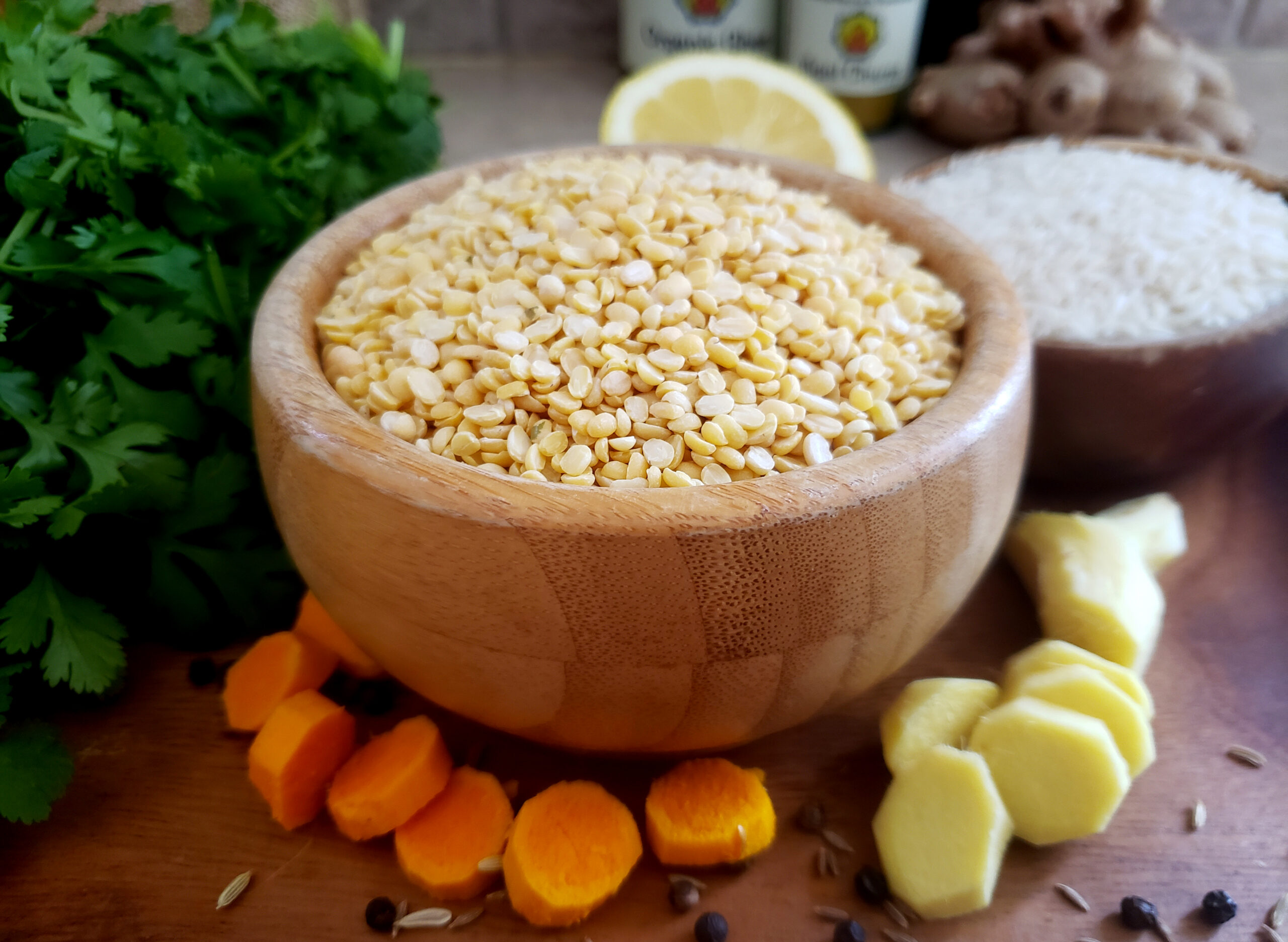
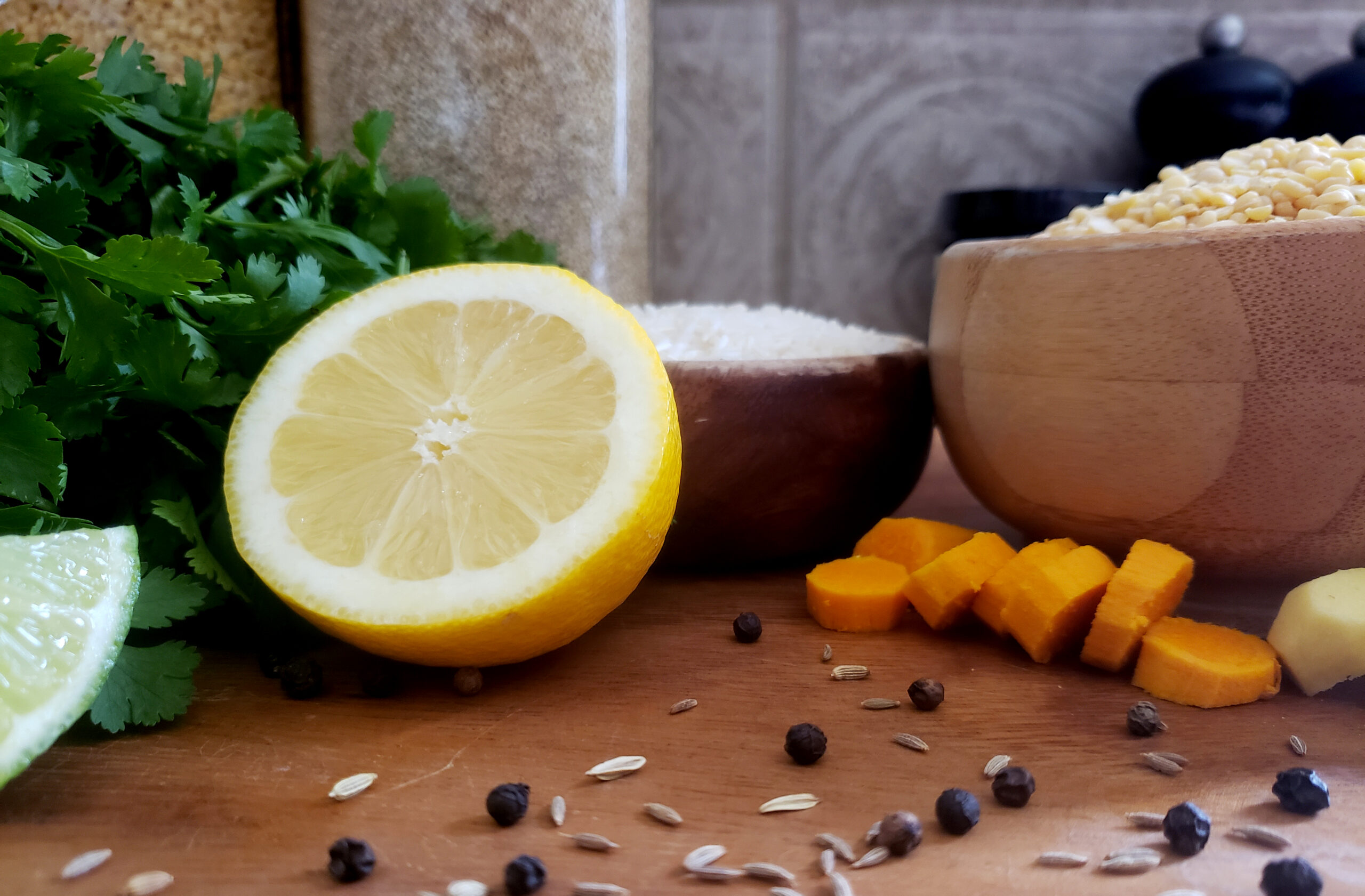
Ingredients
Get your kitchari supplies here!
FOR THE DAL
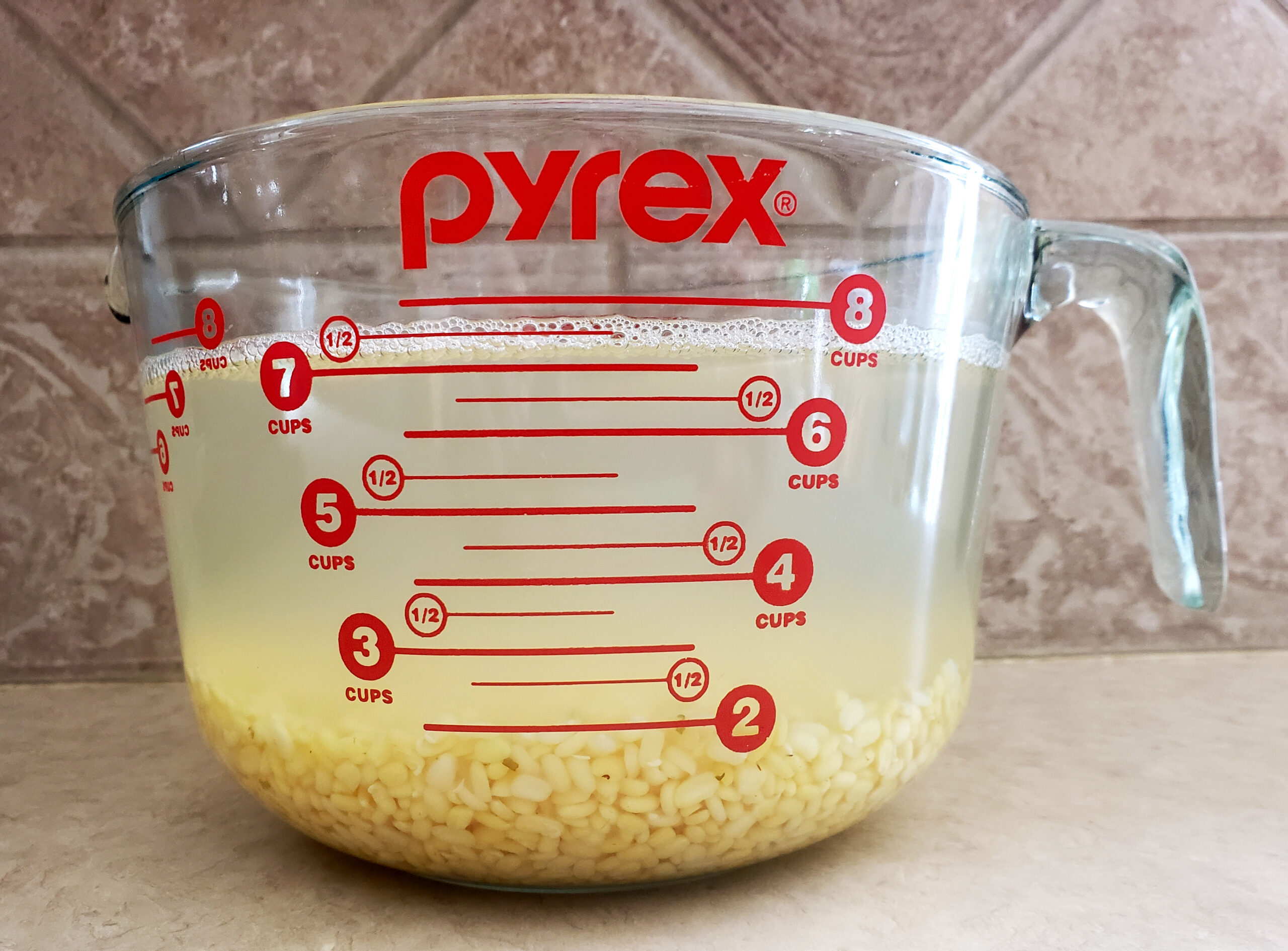
- 1 cup mung dal, soaked overnight and strained
- 3 cups water, bone broth, or veggie broth; make sure broth is salt-free and homemade (if broth is salted, reduce the salt in the recipe)
- 1 tablespoon ghee (or coconut, sesame, or olive oil—use olive oil for high Kapha)
- 1 teaspoon Agni Churna (or your favorite Kitchari Spice blend)
- ⅛ teaspoon cumin seed, whole
- ⅛ teaspoon fennel seed, whole
- ¾ teaspoon pink Himalayan or Mineral salt
- ⅛ teaspoon freshly ground black pepper
- 3 large kale or collard green leaves, stemmed and chopped (substitute with your favorite leafy greens—about 1 packed cup chopped)
- 2” by 1” tube of fresh ginger, finely minced or grated (replace with ½ teaspoon powdered ginger, if needed)
- 1” by 1” tube of fresh turmeric, finely minced or grated (replace with ½ teaspoon powdered turmeric, if needed)
- Ghee for individual servings (optional; omit for Kapha)
- Fresh cilantro leaf, chopped for individual servings (optional)
- Fresh lemon for individual servings (optional; use lime for Pitta)
FOR THE GRAIN
- 1½ cups water
- ⅔ cup basmati rice or quinoa (Kapha use quinoa)
- 1 teaspoon ghee (or oil of choice)
- ¼ teaspoon Agni Churna (or your favorite Kitchari Spice Blend)
- ⅛ teaspoon salt
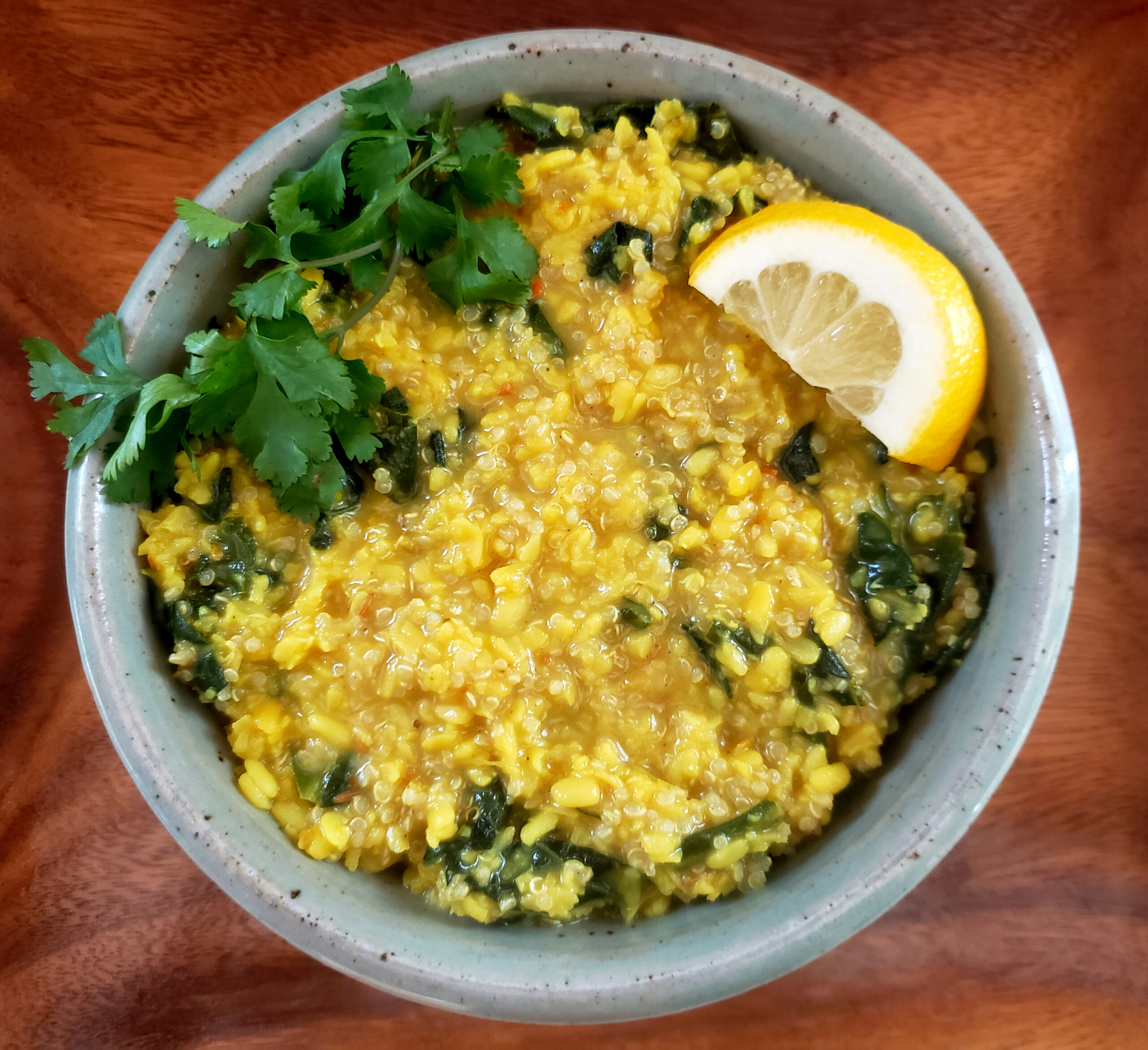
Directions
Click here for a printable copy of this recipe.
PREPARING THE DAL
1. Soak the dal overnight in a large container of water. Strain, discard the water, and rinse before cooking.
NOTE: If a speed soak is needed, use boiling water and soak for 2 to 6 hours. If there is no time for soaking (not recommended), rinse the dal with warm water before cooking. This may increase the cooking time slightly.
2. Add the water or broth to a large saucepan and bring to a boil.
3. While it is heating, stir in ghee, Agni Churna, cumin, fennel, salt, and black pepper.
4. Once boiling, reduce the heat to low-medium and add the mung dal (soaked and strained); stir well.
5. Cook, partially covered, over low-medium heat for 15 minutes.
6. While the dal is cooking, prepare the rice (or quinoa). See “PREPARING THE GRAIN” below.
7. Once the rice and dal are cooking, prepare the greens, ginger, and turmeric.
8. Wash, de-stem, and chop the greens into thin strips.
9. Peel and grate the fresh ginger and turmeric (if using). If a grater or electric spice grinder is not available, you can finely mince with a sharp knife.
NOTE: For ease and quickness, I peel and chop the ginger and turmeric, then use my electric spice grinder, which pulverizes them in seconds.
10. After the dal has been cooking for 15 minutes, add the chopped greens and grated ginger and turmeric (or dried turmeric and ginger, if using).
11. Cook for an additional 10 minutes on low heat, mostly covered. Stir every 3 to 5 minutes. Add more broth or water if the consistency gets too thick for your liking (some individuals prefer thick kitchari, others more soupy).
12. Once done, cover and take off the heat until you are ready to serve.
PREPARING THE GRAIN
1. Soak or rinse the rice (or quinoa) before cooking. I typically soak my quinoa overnight, but only rinse (several times with warm water) when using Basmati rice.
2. Bring the water to a boil in a medium saucepan.
3. Once the water is boiling, reduce the heat to low and add in the rice (or quinoa), ghee (or oil), Agni Churna, and a pinch of salt and pepper. Stir well and cover, leaving a slight crack to avoid overflow.
4. Cook for 10 to 12 minutes, stirring and covering the lid completely around 6 minutes. The rice is done when only s little water remains. Please do not overcook to avoid a mushy rice result!
5. Once the rice is done, turn off the heat but leave the pan on the hot burner. Cover the pan and let it sit for 5 minutes to allow the rice to fluff and any excess liquid to absorb.
SERVING
1. Place a small amount of cooked rice into a bowl. Pour the dal over the rice and blend well. I usually do 2 parts dal to 1 part quinoa (give or take), but some may prefer a 1:1 ratio.
2. For added cleansing effects, garnish with cilantro, lemon juice (lime for Pitta), and/or extra ghee. Add more salt and pepper, if needed.
3. Sit comfortably, eat mindfully, breathe deeply, and enjoy in good company:)
STORAGE
- Kitchari is best on the first day; however, it will keep for up to 3 to 5 days in the refrigerator.
- Store any leftovers in an airtight glass jar or Tupperware.
- Store the rice (or quinoa) in a separate container to avoid the grains getting too mushy. Then combine each serving when it is time to reheat.
REHEATING
- To reheat, blend the dal and rice in a pan and place over a low heat.
- Heat until hot, stirring every 2 to 3 minutes.
- Since the ingredients tend to become slightly dry after refrigeration, it is recommended to add a splash of water (or better yet, broth), extra ghee, and a dash of salt and pepper with each reheated serving.

Get all your kitchari needs with our Kitchari Kits!
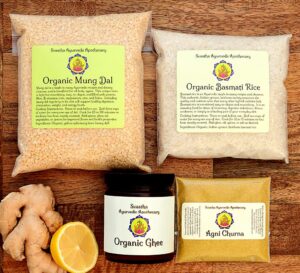
Try our Agni Churna spice blend!
Discover more healthy recipes with my 30-minute Ayurvedic Cookbook!

*All Amazon links are affiliated links that help support Svastha Ayurveda! Thank you for your support:)

Love your model!
Thanks Teri! He is not just cute, he is also a great helper:)
Many blessings,
Danielle
I can’t wait to try this!!
Hi Danielle, I just came across your sight looking for Madeline Huish. I took her/his intensive Shadow/Nadi Yoga classes in Santa Fe back in 2009-2013. We were introduced to the horse pose and will mow find it very helpful. I also find helpful your Ayurveda info/kitchari.
Would you have a contact for Madeline? I lost touch and it would mean alot to me.
I’ll be back in touch re: Ayurveda info. Respectfully….Sharon Bain🤔🙏
Hi Sharon,
Thank you for reaching out! It’s great that you studied with Madeleine in the past, too. I will email you directly, and we can talk more there.
I look forward to connecting:)
Namaste,
Danielle